




The GLP-1 Dilemma for Plan Sponsors

Back to the blog

CPBI Massimo Nini 2026-1

Between clinical promise and financial pressure: an interview with Massimo Nini

GLP‑1 medications–drugs designed to treat Type 2 diabetes but that are increasingly used for weight management–are rapidly transforming the group benefits landscape. Between growing member demand, rising costs, and the obvious health benefits, plan sponsors have choices to make. Through interactions with AGA consultants, they tell us that they sometimes feel confused and are looking for guidance to solve this health vs. costs conundrum.

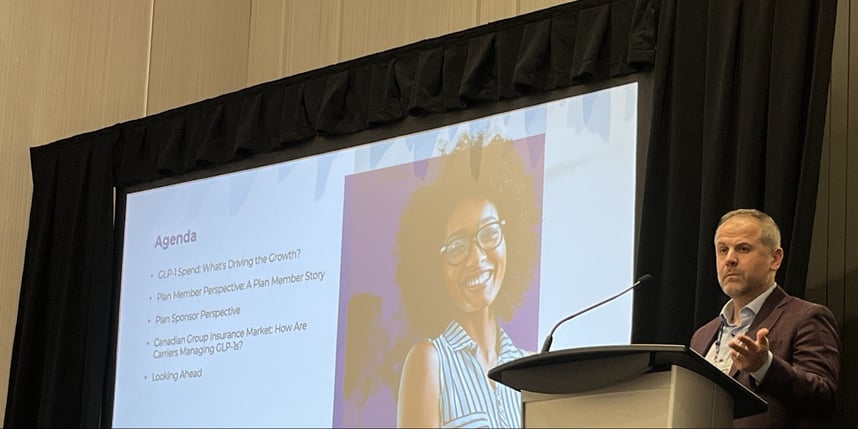
Our Senior Vice President, Consulting, Underwriting and Actuarial Services, Massimo Nini, had the opportunity to bring up this topic from various angles as a speaker at the latest Canadian Pension and Benefits Institute (CPBI) National Conference in Quebec City, earlier in June. We’ve sat together to recap what was discussed at the conference, including approaches available to plan sponsors, and add some perspective to better understand the issues at stake.

Massimo, GLP-1s are indeed a very popular topic right now. You have been asked to provide your perspective in an industry article, we talked about it in AGA’s Innovate to Lead report, and now this conference that also led to some media coverage. Why are GLP‑1 drugs getting so much attention?

Massimo Nini (MN): The growth of GLP-1s has been nothing short of remarkable. We’re seeing a convergence of factors: rising rates of diabetes and obesity, strong clinical outcomes, and rapid adoption among patients.

To put it in perspective, GLP‑1s represented about 25% of diabetes-related drug spend in 2021. By 2025, that number had climbed to nearly 57%1. That’s a fundamental shift in just a few years.

At the same time, these drugs are five to six times more expensive than traditional treatments. So even moderate uptake has a significant impact on plan costs.

What’s driving such strong demand?

MN: At the core, these drugs deliver meaningful benefits. They improve glycemic control while also supporting weight management, which is often critical for patients.

But there’s also been a shift in how we view obesity. It’s increasingly recognized as a chronic condition rather than a lifestyle choice. That change is influencing how patients, physicians, and employers approach treatment. Today, roughly 30% of Canadians are considered obese, yet only a small portion are using pharmacological treatment. So, there’s still significant room for growth.

Some health decisions are not just columns of numbers; they are human stories. I believed you used a powerful example at the conference?

MN: The impact can be significant, and sometimes underestimated. During the CPBI panel, I used a real-life testimonial of a plan member who was using a GLP-1 drug, paying out of their pocket because the impact on general health, weight management and self-esteem was remarkable. However, this member was forced to discontinue treatment due to cost, with serious consequences: weight regain, worsening metabolic health, and even mental health issues. For some, these medications become essential to maintaining overall stability. This reinforces that the issue goes far beyond appearance—it’s about quality of life, long-term health, and preventing more serious conditions.

Blogue Massimo discussionDoes that mean these drugs should be covered in private plans for all types of uses?

MN: It’s not that simple. On the positive side, the potential benefits are compelling: improved overall health, reduced risk of serious illness, and lower disability incidence over time–all positives for a plan sponsor. However, there are uncertainties. The long-term effects are not fully known, and importantly, the benefits are dependent on continuous use. If treatment stops, outcomes can reverse quickly.

Employers have traditionally used benefits to attract and retain talent while supporting productivity. But GLP‑1s are testing this model. We’re dealing with high-cost, long-term therapies. Plan sponsors must strike a balance between accessibility, equity, and financial sustainability.

Are plan sponsors ready to bear the additional costs as they will reap the benefits of healthier employees? Are employees open to pay higher premiums for broader coverage? If you’re adding GLP-1s, does that mean you will remove another piece of coverage to stabilize your plan’s cost? These would be some questions to ask to position yourself, as an employer, on the continuum of possibilities.

Let’s say a plan sponsor wants to cover GLP-1s for weight management. How would you suggest they structure their coverage?

MN: There’s no one-size-fits-all solution. Some plans exclude obesity drugs altogether. Others apply annual maximums or use restrictive formularies. At the other end of the spectrum, some offer full, uncapped coverage. We’re also seeing more nuanced approaches, such as tiered formularies or differentiated reimbursement levels. In terms of pricing, adding obesity drug coverage can increase health costs by about 0.5% to 4%, depending on utilization. It’s not negligible.

All in all, it’s worth a conversation. The key is alignment with organizational objectives—whether that’s improving access, controlling costs, or supporting a broader health and wellness strategy.

From a cost standpoint, something that can move the needle – no pun intended – is the arrival of generic versions of GLP-1 drugs. Do you think it will make plan sponsors revisit their stance?

MN: Potentially—but not immediately. Canada has already approved generic versions of semaglutide, which could bring costs down over time, although availability may take a while.

At the same time, innovation is accelerating. New drug combinations, next-generation therapies, and even oral versions are on the horizon. Will it counterbalance the lower cost effect of generics? It’s too early to tell.

What are you seeing in your “crystal ball” regarding the future of GLP-1 drug coverage?

MN: The only sure thing is that this topic will continue to be top-of-mind for plan sponsors for months and years to come. Three big questions stand out.

First: can employers continue to justify excluding obesity drugs, given their effectiveness and the recognition of obesity as a chronic condition?

Second: how quickly will costs continue to rise, and to what extent?

Third: when—and how—will these investments translate into measurable outcomes, such as improved productivity or reduced absenteeism? This is possibly the biggest challenge where plan sponsors need help to make informed decisions. Our AGA consultants are there to help!

New call-to-action

1 IQVIA Private Pay Direct Drug Program

The GLP-1 Dilemma for Plan Sponsors

CPBI Massimo Nini 2026-1

Between clinical promise and financial pressure: an interview with Massimo Nini

GLP‑1 medications–drugs designed to treat Type 2 diabetes but that are increasingly used for weight management–are rapidly transforming the group benefits landscape. Between growing member demand, rising costs, and the obvious health benefits, plan sponsors have choices to make. Through interactions with AGA consultants, they tell us that they sometimes feel confused and are looking for guidance to solve this health vs. costs conundrum.

Our Senior Vice President, Consulting, Underwriting and Actuarial Services, Massimo Nini, had the opportunity to bring up this topic from various angles as a speaker at the latest Canadian Pension and Benefits Institute (CPBI) National Conference in Quebec City, earlier in June. We’ve sat together to recap what was discussed at the conference, including approaches available to plan sponsors, and add some perspective to better understand the issues at stake.

Massimo, GLP-1s are indeed a very popular topic right now. You have been asked to provide your perspective in an industry article, we talked about it in AGA’s Innovate to Lead report, and now this conference that also led to some media coverage. Why are GLP‑1 drugs getting so much attention?

Massimo Nini (MN): The growth of GLP-1s has been nothing short of remarkable. We’re seeing a convergence of factors: rising rates of diabetes and obesity, strong clinical outcomes, and rapid adoption among patients.

To put it in perspective, GLP‑1s represented about 25% of diabetes-related drug spend in 2021. By 2025, that number had climbed to nearly 57%1. That’s a fundamental shift in just a few years.

At the same time, these drugs are five to six times more expensive than traditional treatments. So even moderate uptake has a significant impact on plan costs.

What’s driving such strong demand?

MN: At the core, these drugs deliver meaningful benefits. They improve glycemic control while also supporting weight management, which is often critical for patients.

But there’s also been a shift in how we view obesity. It’s increasingly recognized as a chronic condition rather than a lifestyle choice. That change is influencing how patients, physicians, and employers approach treatment. Today, roughly 30% of Canadians are considered obese, yet only a small portion are using pharmacological treatment. So, there’s still significant room for growth.

Some health decisions are not just columns of numbers; they are human stories. I believed you used a powerful example at the conference?

MN: The impact can be significant, and sometimes underestimated. During the CPBI panel, I used a real-life testimonial of a plan member who was using a GLP-1 drug, paying out of their pocket because the impact on general health, weight management and self-esteem was remarkable. However, this member was forced to discontinue treatment due to cost, with serious consequences: weight regain, worsening metabolic health, and even mental health issues. For some, these medications become essential to maintaining overall stability. This reinforces that the issue goes far beyond appearance—it’s about quality of life, long-term health, and preventing more serious conditions.

Blogue Massimo discussionDoes that mean these drugs should be covered in private plans for all types of uses?

MN: It’s not that simple. On the positive side, the potential benefits are compelling: improved overall health, reduced risk of serious illness, and lower disability incidence over time–all positives for a plan sponsor. However, there are uncertainties. The long-term effects are not fully known, and importantly, the benefits are dependent on continuous use. If treatment stops, outcomes can reverse quickly.

Employers have traditionally used benefits to attract and retain talent while supporting productivity. But GLP‑1s are testing this model. We’re dealing with high-cost, long-term therapies. Plan sponsors must strike a balance between accessibility, equity, and financial sustainability.

Are plan sponsors ready to bear the additional costs as they will reap the benefits of healthier employees? Are employees open to pay higher premiums for broader coverage? If you’re adding GLP-1s, does that mean you will remove another piece of coverage to stabilize your plan’s cost? These would be some questions to ask to position yourself, as an employer, on the continuum of possibilities.

Let’s say a plan sponsor wants to cover GLP-1s for weight management. How would you suggest they structure their coverage?

MN: There’s no one-size-fits-all solution. Some plans exclude obesity drugs altogether. Others apply annual maximums or use restrictive formularies. At the other end of the spectrum, some offer full, uncapped coverage. We’re also seeing more nuanced approaches, such as tiered formularies or differentiated reimbursement levels. In terms of pricing, adding obesity drug coverage can increase health costs by about 0.5% to 4%, depending on utilization. It’s not negligible.

All in all, it’s worth a conversation. The key is alignment with organizational objectives—whether that’s improving access, controlling costs, or supporting a broader health and wellness strategy.

From a cost standpoint, something that can move the needle – no pun intended – is the arrival of generic versions of GLP-1 drugs. Do you think it will make plan sponsors revisit their stance?

MN: Potentially—but not immediately. Canada has already approved generic versions of semaglutide, which could bring costs down over time, although availability may take a while.

At the same time, innovation is accelerating. New drug combinations, next-generation therapies, and even oral versions are on the horizon. Will it counterbalance the lower cost effect of generics? It’s too early to tell.

What are you seeing in your “crystal ball” regarding the future of GLP-1 drug coverage?

MN: The only sure thing is that this topic will continue to be top-of-mind for plan sponsors for months and years to come. Three big questions stand out.

First: can employers continue to justify excluding obesity drugs, given their effectiveness and the recognition of obesity as a chronic condition?

Second: how quickly will costs continue to rise, and to what extent?

Third: when—and how—will these investments translate into measurable outcomes, such as improved productivity or reduced absenteeism? This is possibly the biggest challenge where plan sponsors need help to make informed decisions. Our AGA consultants are there to help!

New call-to-action

1 IQVIA Private Pay Direct Drug Program